The Tempest
by William Shakespeare

Prospero & Miranda with Ariel confront Caliban
- Henry Fuseli's "The Enchanted Island: Before the Cell of Prospero" (1797)
|
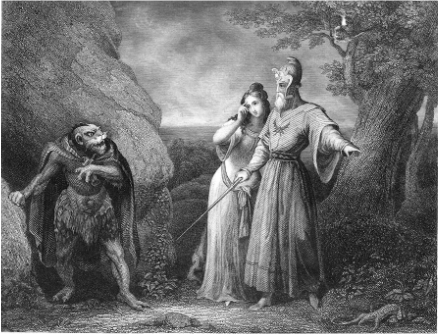
Prospero & Miranda confront Caliban
- C. W. Sharpe's Engraving (1875)
|
Audio Stopping Places - ACT ONE: Ends 27:45 ACT TWO: Ends 52:53
ACT THREE: Ends 1:10:46 ACT FOUR: Ends 1:25:38 ACT FIVE: Ends 1:43:10
ACT THREE: Ends 1:10:46 ACT FOUR: Ends 1:25:38 ACT FIVE: Ends 1:43:10
A Detailed Summary of the Action &
An Explanation of the Principle Characters
Historical Context & Critical Reviews of The Tempest
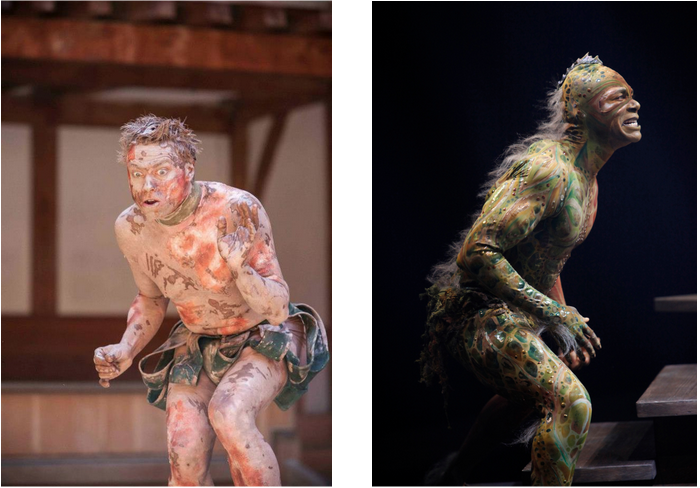
Left: Caliban, Globe 2013 Production
- Right: Caliban, 2010 Stratford Shakespeare Festival
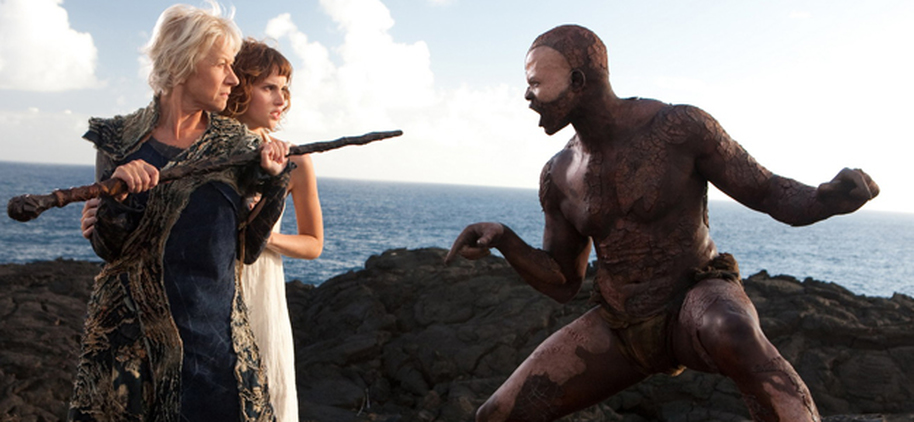
Prospera & Miranda confront Caliban
- From Julie Taymor's THE TEMPEST (2010)
Jonathan Bate & Julie Taymor on Djimon Hounsou’s Caliban
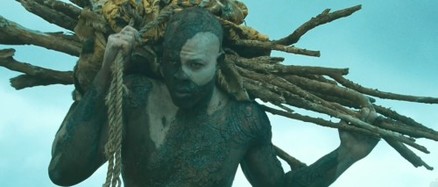 Caliban from Act 2, scene ii Caliban from Act 2, scene ii
The casting as Caliban of Djimon Hounsou, born in Benin, West Africa, might suggest that this movie will offer a reading of The Tempest that emphasizes racial oppression and colonial dispossession. The play was written at the dawn of the British Empire. It draws on information about the Virginia settlement and the shipwreck, near Bermuda, of the colonial governor. The dynamic of Caliban’s enslavement and the ironic reference to a “brave new world” has made The
Tempest a key text in the story of empire and subsequently of postcolonialism . . . . Some viewers may make these connections, but Taymor has absolutely resisted the temptation to foreground them in a polemical or didactic way. She is too interested in the dynamics of the relationships between the characters, in the poetry and its supporting music, in the colors and textures of the environment, above all in the transformational magic of art itself, to be distracted by “politically correct” reading. Where Hounsou’s African inheritance genuinely is relevant is in the area of magic. In Benin, witchcraft is still real. In the movement of his body, the play of his words, the darkness of his imagined fears, he taps into a dimension that cannot be contained by the constraints of Western rationalism. ---- Bate, Jonathan. “Enter Ariel, Invisible.” Foreword to Julie Taymor, The Tempest: adapted from the play by William Shakespeare. New York: Abrams, 2010. 7-11. |
In casting an African in this role, one automatically brings to the forefront the obvious themes of colonialization and usurpation that clearly were part of Shakespeare’s worldview, derived from
stories culled from explorations to Africa and the New World. But in order to truly serve Shakespeare’s unique vision of this character, one must go beyond sociopolitical commentary achieved through a casting choice. Djimon Hounsou went through a four-hour makeup ordeal every day to achieve the look of his Caliban. His skin was made to resemble the island's cracked red earth and black lava rock, with raised scars of obscenities he had carved into his flesh . . . . The nickname “Mooncalf,” endearingly coined by Stephano for Caliban, suggested the white circular moon that frames his own blue eye, which in itself was motivated by the notion that he is the whelp of that “blue-eyed hag,” Sycorax. The “calf” part of the equation is delivered in the maplike patches of white on black skin that add to the “otherness” of this unique racial mash-up. The webbing between his fingers adds that touch of monster fantasy that speaks to the “strange fish,” as Trinculo calls him. All in all, this Caliban, both beautiful and grotesque, is the island; Nature personified . . . In casting Djimon Hounsou in this role we were privileged to have not only a great actor but one who brought with him experience, belief, and respect for the power of white and black magic. His personal stories of sorcery in his country, Benin, were both inspiring and harrowing. There was never any question in Djimon’s mind that the figure Helen [Mirren] was playing, the sorceress, could control Caliban. He is the “natural” that Prospera tries and fails to reform in her nurturing. Their clashes leave the audience discomforted, unsure as to whom to root for, as Shakespeare never chooses sides. Djimon’s Caliban is multifaceted: he can be physically threatening and violent in one scene and naïve and puppylike in another. He is comedic, foolish, elementally human, and profoundly tragic, bestowed with the innate intelligence to speak some of the most elegant and moving poetry of The Tempest. --- Taymor, Julie. Introduction. Julie Taymor, The Tempest. 18. |
Film sequence from THE TEMPEST (2010), Directed by Julie TaymorThough we watched a longer sequence in class as a part of the full film, this one-minute extract from the sequence should serve as an adequate reminder of the sequence's objectives. Consider using it as you compose your appraisal of the selected scene.
|
|
